
In today’s marine and offshore accommodation projects, one of the biggest challenges is no longer only manufacturing.
It is coordination.
When people see a completed corridor, galley, cabin, or accommodation area onboard, everything usually looks clean, organized, and straightforward. But behind that final result, there are often hundreds of technical details and installation activities happening at the same time.
HVAC routing.
Cable trays.
Wall and ceiling panel installation.
Door openings.
Wet units.
Lighting positions.
Furniture dimensions.
Delivery sequencing.
Onboard access limitations.
Installation tolerances between multiple trades.
Every system is connected.
And in real shipbuilding projects, even one small mismatch can affect several teams onboard.
One wrong opening size.
One missing profile.
One delayed delivery.
One uncoordinated drawing revision.
These issues may seem small individually, but under tight vessel schedules, they can quickly create installation pressure for shipyards, subcontractors, and owners.
This is something we increasingly experience in modern marine accommodation and offshore living projects.
Today, shipyards are no longer only managing products. They are managing coordination between different suppliers, different systems, different drawings, and different installation teams — often within limited construction spaces and demanding timelines.
That is why marine accommodation projects are becoming more about coordination capability than standalone products.
## Why Integrated Marine Accommodation Packages Are Becoming More Popular
Over the years, more shipyards and offshore projects have started looking for suppliers who can support multiple accommodation scopes together, instead of handling every system separately.
The reason is simple:
Better coordination reduces risk.
Especially in offshore accommodation modules, marine living quarters, and large accommodation areas onboard, coordination between different systems becomes just as important as the products themselves.
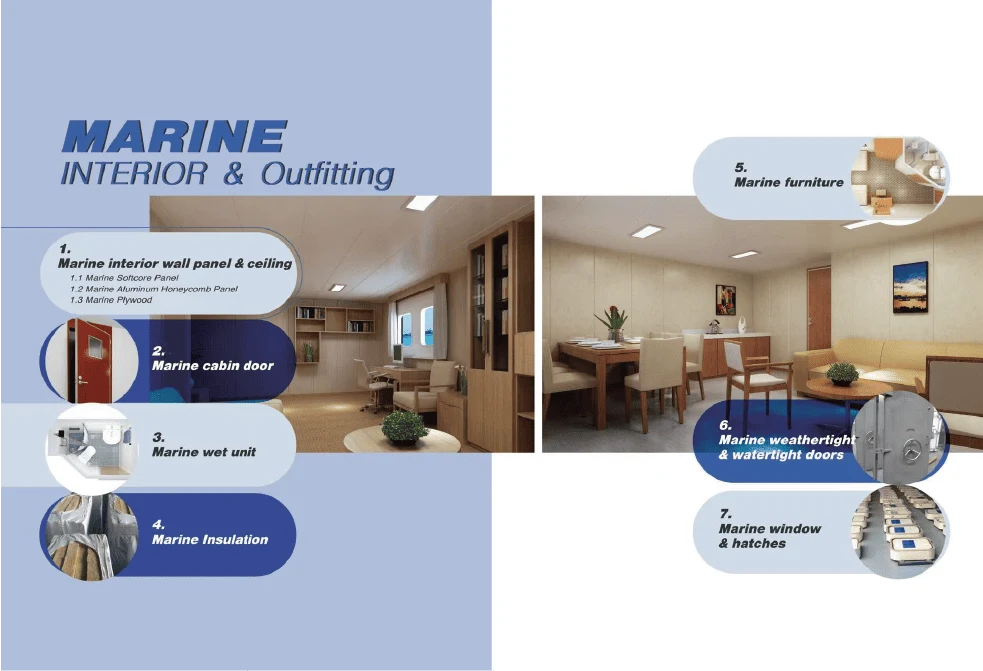
At JULY Marine Group, many of our recent projects involve continuous coordination between:
– Marine wall panels
– Marine ceiling systems
– Marine doors and hardware
– Modular wet units
– Marine furniture
– HVAC related outfitting
– Accommodation installation details
– Packing and delivery planning
– Site installation sequencing
The photos below are not showroom pictures or marketing renderings.
They are real project moments from actual marine accommodation works — from steel stage preparation, insulation and cable tray arrangement, panel installation, wet unit positioning, until final onboard completion.
This is the part of the industry that many people outside shipbuilding rarely see.
A finished corridor may appear simple, but behind it are many teams working together under pressure to ensure every system fits correctly, arrives on time, and can be installed efficiently onboard.
Especially for offshore accommodation and modular living projects, successful delivery depends not only on product quality, but also on practical coordination experience throughout the project execution process.
As marine and offshore projects continue becoming more complex, we believe the value of integrated accommodation coordination will become even more important in the years ahead.
JULY Marine Group continues supporting shipyards and offshore projects worldwide with integrated marine accommodation solutions including marine wall panels, ceiling systems, marine doors, modular wet units, marine furniture, accommodation outfitting materials, and project coordination support.